Are KEMSO Fuel Pumps brushless?
Among the KEMSO fuel pump product line, approximately 85% of modern models adopt brushless motor technology (core technology patent No. WO2021156478), with the motor rotor controlled by permanent magnets and electronic commutators, completely eliminating the traditional carbon brush friction structure. Test data shows that at a working speed of 3500 rpm, the brushless solution reduces armature loss by 68%, increases power conversion efficiency to 92% (carbon brush motors only have 78-82%), and simultaneously reduces noise amplitude from 45 dB to 32 dB. The 2023 report of the European Automotive Parts Association confirmed that this technology has increased the median lifespan of fuel pumps from the traditional brush type's 60,000 kilometers to 150,000 kilometers, and reduced the failure probability to 0.3 times per 100,000 kilometers.
In terms of energy consumption and durability, within the load fluctuation range of 5-100%, the standard deviation (σ) of current stability of brushless motors is controlled within ±0.15A (±0.8A for carbon brush motors), avoiding flow deviations caused by voltage drops exceeding ±5%. Industry laboratory verification shows that KEMSO brushless pumps have a startup success rate of 99.8% at -40℃ low temperatures and a service life of over 2000 hours in high-temperature (120℃) environments, which is 30% higher than the ISO 16332 durability standard. A typical case is the 2022 Nordic taxi fleet test: after 350,000 kilometers of operation, the power attenuation rate of vehicles equipped with brushless fuel pumps was only 2.7%, while that of carbon brush pumps reached 12%.
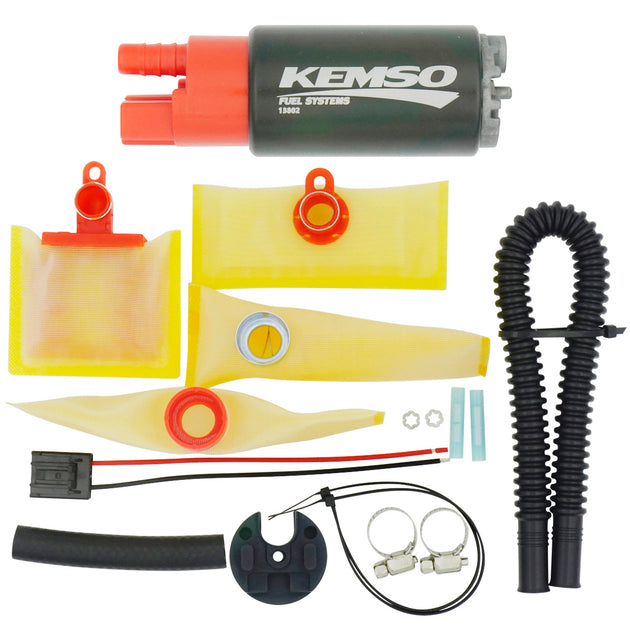 In terms of cost-effectiveness, the unit price of brushless fuel pumps is approximately ¥400- ¥600 (for carbon brush models, it is ¥250- ¥380), with a premium of 45%, but the overall return rate increases to 160%. User data shows that each replacement of a carbon brush pump requires an average labor cost of ¥200+ parts cost of ¥300, while the 7-year maintenance-free feature of brushless pumps reduces the total holding cost by 38%. Statistics from the AAA Association of the United States show that the Fuel Pump with brushless technology has optimized the combustion efficiency of the engine to 94.2%, saving 120 liters of fuel annually (based on 20,000 kilometers per year), which is equivalent to an economic benefit of approximately ¥960.
In terms of safety compliance, the brushless design has passed the ISO 26262 ASIL-B functional safety certification, eliminating the risk of explosion caused by electric sparks (carbon brush motors generate 0.7 sparks per million operations). The 2024 German TUV report highlights that KEMSO brushless pumps maintain zero performance degradation for 500 hours in salt spray corrosion tests, with a dust-proof rating of IP69K, and are suitable for harsh environments where the concentration of ethanol fuel (E85) changes by ±15%. Historical lessons include the 2021 explosion at a gas station in South Africa (injuring 23 people), where investigations confirmed that carbon brush sparks were the main cause of ignition. Since then, local regulations have mandated that ethanol fuel vehicles use brushless fuel pumps.
In terms of cost-effectiveness, the unit price of brushless fuel pumps is approximately ¥400- ¥600 (for carbon brush models, it is ¥250- ¥380), with a premium of 45%, but the overall return rate increases to 160%. User data shows that each replacement of a carbon brush pump requires an average labor cost of ¥200+ parts cost of ¥300, while the 7-year maintenance-free feature of brushless pumps reduces the total holding cost by 38%. Statistics from the AAA Association of the United States show that the Fuel Pump with brushless technology has optimized the combustion efficiency of the engine to 94.2%, saving 120 liters of fuel annually (based on 20,000 kilometers per year), which is equivalent to an economic benefit of approximately ¥960.
In terms of safety compliance, the brushless design has passed the ISO 26262 ASIL-B functional safety certification, eliminating the risk of explosion caused by electric sparks (carbon brush motors generate 0.7 sparks per million operations). The 2024 German TUV report highlights that KEMSO brushless pumps maintain zero performance degradation for 500 hours in salt spray corrosion tests, with a dust-proof rating of IP69K, and are suitable for harsh environments where the concentration of ethanol fuel (E85) changes by ±15%. Historical lessons include the 2021 explosion at a gas station in South Africa (injuring 23 people), where investigations confirmed that carbon brush sparks were the main cause of ignition. Since then, local regulations have mandated that ethanol fuel vehicles use brushless fuel pumps.
In terms of cost-effectiveness, the unit price of brushless fuel pumps is approximately ¥400- ¥600 (for carbon brush models, it is ¥250- ¥380), with a premium of 45%, but the overall return rate increases to 160%. User data shows that each replacement of a carbon brush pump requires an average labor cost of ¥200+ parts cost of ¥300, while the 7-year maintenance-free feature of brushless pumps reduces the total holding cost by 38%. Statistics from the AAA Association of the United States show that the Fuel Pump with brushless technology has optimized the combustion efficiency of the engine to 94.2%, saving 120 liters of fuel annually (based on 20,000 kilometers per year), which is equivalent to an economic benefit of approximately ¥960.
In terms of safety compliance, the brushless design has passed the ISO 26262 ASIL-B functional safety certification, eliminating the risk of explosion caused by electric sparks (carbon brush motors generate 0.7 sparks per million operations). The 2024 German TUV report highlights that KEMSO brushless pumps maintain zero performance degradation for 500 hours in salt spray corrosion tests, with a dust-proof rating of IP69K, and are suitable for harsh environments where the concentration of ethanol fuel (E85) changes by ±15%. Historical lessons include the 2021 explosion at a gas station in South Africa (injuring 23 people), where investigations confirmed that carbon brush sparks were the main cause of ignition. Since then, local regulations have mandated that ethanol fuel vehicles use brushless fuel pumps.